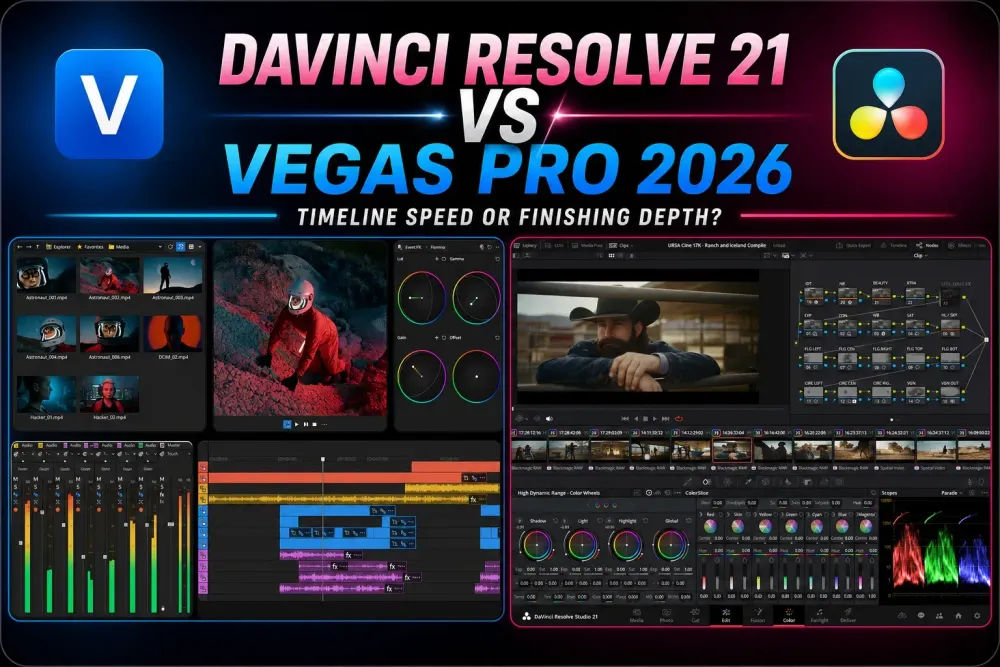
Quick answer: choose VEGAS Pro 2026 when you edit on Windows 11, want event-level trimming, effects and audio close to one flexible timeline, and value the Boris FX bundles enough to pay for them. Choose DaVinci Resolve 21 when you want a permanent free edition, Windows/macOS/Linux support, deeper color, Fusion and Fairlight, collaboration or a workflow built to survive larger projects.
The old shorthand is stale. Current VEGAS is no longer a Sony product or a MAGIX release: Boris FX acquired it in March 2026 and launched VEGAS Pro 2026. That change affects the version, account system, plan lineup, included tools and even the hardware page. A comparison built around VEGAS 22 or 23 is now answering yesterday's question.
I would not choose either editor from a feature grid alone. This guide uses current official pages checked on August 28, 2026, then reduces the decision to one representative project: the same source codec, timeline, title, audio repair, color pass, revision and export in both apps.
DaVinci Resolve vs VEGAS Pro at a glance
| Decision | Practical difference |
|---|---|
| Best first fit | VEGAS Pro 2026: solo Windows editing with fast event-level control. Resolve 21: end-to-end post-production that can grow into a team workflow. |
| Free option | VEGAS: full-featured 15-day trial, not a permanent free tier. Resolve: capable Free edition with no normal export watermark within its limits. |
| Paid model | VEGAS: monthly, annual and selected perpetual tiers. Resolve: Studio is a one-time purchase. |
| Operating systems | VEGAS: current official requirement is Windows 11. Resolve: Windows, macOS and Linux. |
| Editing model | VEGAS: most work stays close to one customizable timeline. Resolve: Cut/Edit, Fusion, Color, Fairlight and Deliver have distinct jobs. |
| Color, VFX and audio | VEGAS: useful timeline-integrated tools and OFX expansion. Resolve: deeper dedicated finishing environments. |
| Existing project move | VEGAS: export documented Resolve XML and archive the media. Resolve: conform the XML, rebuild unsupported work and compare a reference export. |
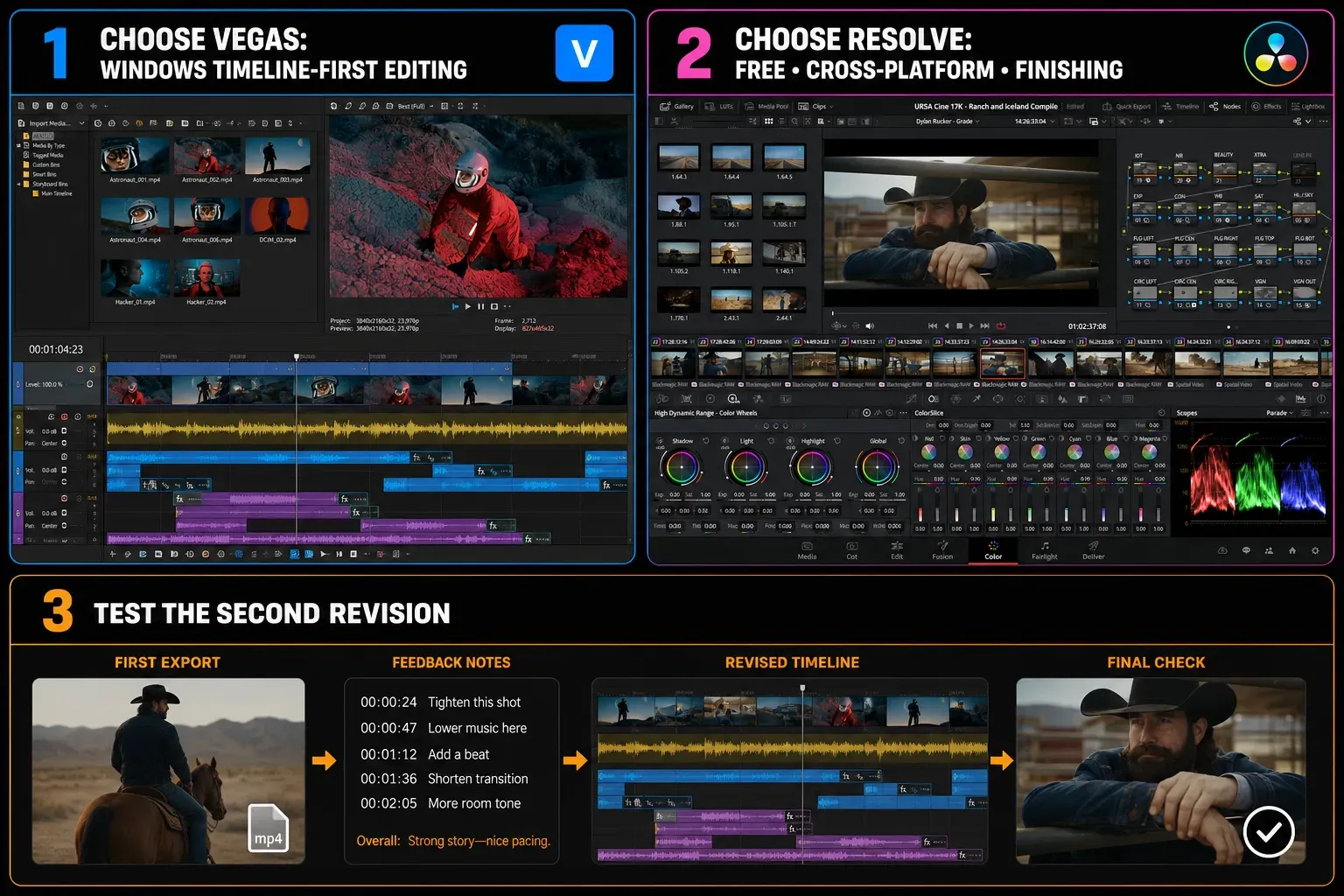
This is not a beginner-versus-professional split. VEGAS has multicam, planar tracking, compositing, color controls, audio buses and third-party OFX support. Resolve also has a fast Cut page and conventional Edit page. The meaningful difference is where each app puts complexity and how much of the wider post pipeline you need.
The DaVinci Resolve comparisons hub keeps this decision separate from Premiere Pro, Final Cut Pro, CapCut and Resolve Free versus Studio. This URL should own only the Resolve-versus-VEGAS intent.
First, stop calling the current product Sony VEGAS
The name persists in searches because Sony sold the software years ago and many editors learned on those versions. The current ownership change is newer and more important: the Boris FX acquisition announcement is dated March 30, 2026 and covers VEGAS Pro, Sound Forge and Acid Pro. VEGAS Pro 23 and earlier remain legacy MAGIX products; VEGAS Pro 2026 is the first Boris FX release.
That distinction matters when you compare screenshots, license advice or troubleshooting. An old activation-key guide, MAGIX Hub tutorial or VEGAS 22 price does not describe the current Boris FX account flow and 2026 editions. Search with the exact version before applying a fix.
Price: Resolve starts free; VEGAS now has three tiers
Blackmagic's current Resolve page lists DaVinci Resolve Free at $0. Normal exports do not receive a built-in watermark, although the Free edition has documented codec, resolution and feature limits. The separate Resolve cost guide explains where Studio becomes necessary.
The observed US Resolve Studio page listed $295 as a one-time purchase. Studio adds the DaVinci AI Neural Engine, extra Resolve FX, advanced noise reduction, Magic Mask, higher-end format support and other professional tools. There is no Resolve subscription tier to keep active.
Boris FX's current VEGAS pricing page advertises subscription and perpetual options starting at $17.95 per month or $219.95. The dated launch price table gives the fuller comparison:
| Plan | US prices observed August 28, 2026 |
|---|---|
| VEGAS Pro | $17.95 monthly, $99.95 annual or $219.95 perpetual. |
| VEGAS Pro Plus | $24.95 monthly, $149.95 annual or $299.95 perpetual. |
| VEGAS Pro Ultimate | $39.95 monthly or $199.95 annual; the official table does not offer Ultimate perpetual. |
| VEGAS trial | 15 days with full access to Ultimate; Windows only and no credit card required. |
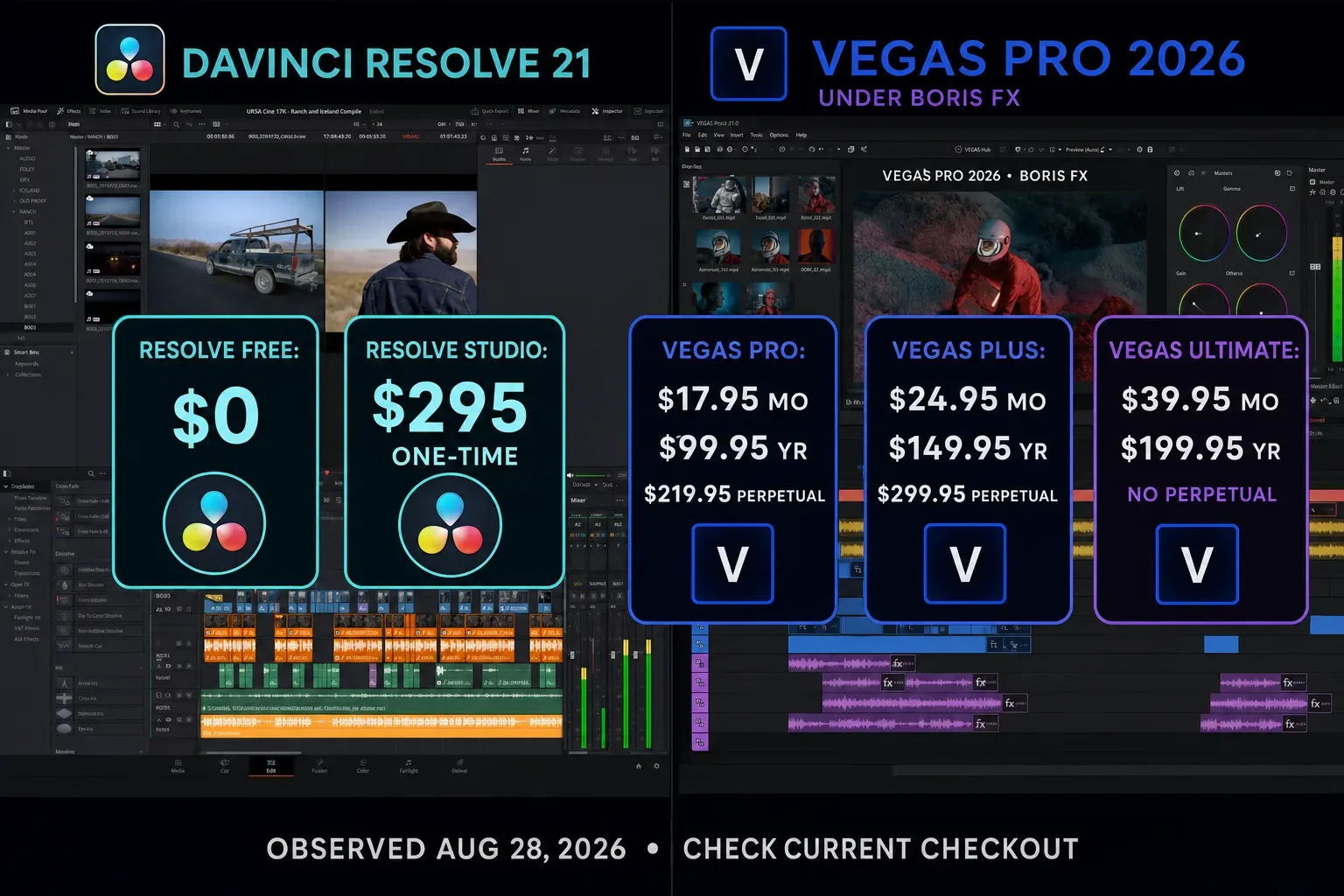
Prices, tax and promotions can change, so treat those as dated observations rather than a promise. More importantly, compare the edition contents. Plus adds Mocha VEGAS, Particle Illusion, Sound Forge and CrumplePop VST tools. Ultimate adds a wider Boris FX bundle, including Mocha Pro, Optics and Continuum VFX, but is subscription-only in the current lineup.
If you only need the editor, Resolve Free is difficult to beat on entry cost. VEGAS earns its price when its timeline saves you time or the bundled tools replace purchases you would make anyway. Paying for Ultimate to use one transition pack is not a workflow strategy.
Editing workflow: timeline events versus dedicated pages
VEGAS is tactile. Drop media on the timeline, trim an event, overlap two events for a crossfade, apply an effect at event or track level, adjust audio and keep moving. Its windows are customizable, and the interface does not force the edit through a formal page sequence.
The current VEGAS feature guide documents timeline event editing, track compositing, OFX keyframes, 3D plane positioning, planar tracking, multicam and input buses. Those are serious tools. A long-time VEGAS editor can be extremely fast because fades, envelopes, events and audio are all part of the same editing grammar.
Resolve separates jobs. Cut and Edit handle editorial; Fusion handles node compositing; Color handles grading and color management; Fairlight handles routing, buses, automation and delivery; Deliver handles output. The first week feels less direct because the app makes the post-production structure visible.
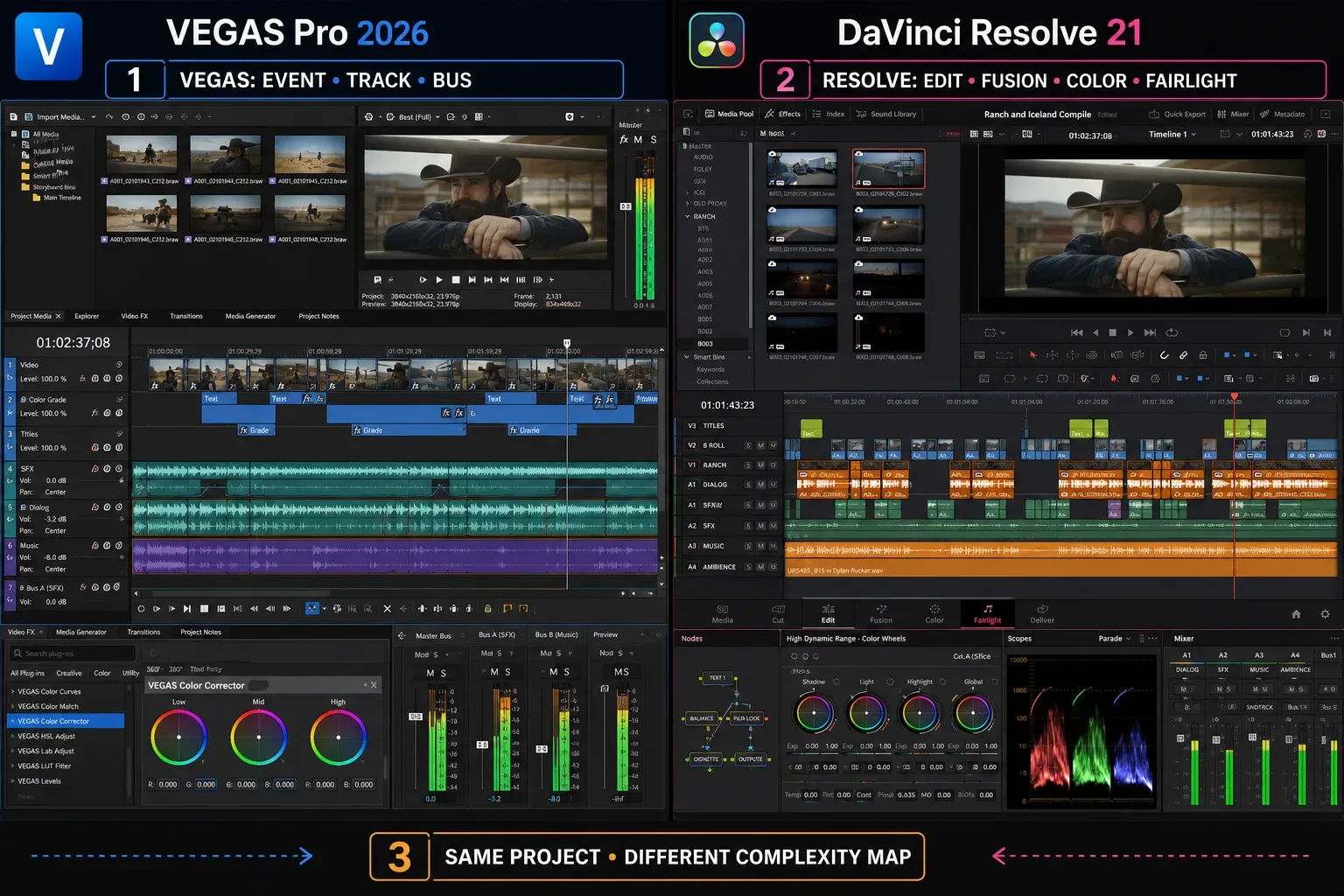
Neither model wins by itself. VEGAS can be faster when a solo editor owns the entire job and knows the shortcuts. Resolve becomes easier to reason about when a composite, grade or mix grows beyond the edit. Test the second revision, not only the time to the first rough export.
If Resolve feels slow only because the keys are unfamiliar, start with the Resolve keyboard shortcuts guide. Rebuild the five VEGAS commands you use most before judging the whole interface.
Color, effects and audio: convenience versus finishing depth
VEGAS Pro 2026 can grade inside the edit, work with curves, wheels, LUTs and HDR material, animate OFX, track planes, composite tracks and mix a substantial project. Its directness is useful for YouTube, event, corporate, music and training work where one editor must turn around a clean result quickly.
Resolve's advantage is not a magic “better image” button. The Color page gives node trees, groups, tracked Power Windows, galleries, versions, color management and a workflow designed to match many shots. Fusion gives a dedicated node compositor. Fairlight supports sessions where routing, automation, loudness and deliverables are part of the job rather than an afterthought.
A bad Resolve grade can still look worse than a disciplined VEGAS grade. Choose Resolve for control, diagnosis and repeatability. Choose VEGAS when the integrated controls are enough and the timeline speed is worth more than the deeper finishing architecture.
AI and bundles: check which features require a subscription
The VEGAS Pro 2026 release page adds the Continuum Title Pack, improved AI Z-Depth, ProRes RAW support and NVIDIA Blackwell acceleration. Those additions make the current release materially different from VEGAS 23.
Two attractive AI features have a license boundary: fully offline speech-to-text and text-to-speech are subscription-only. Storyblocks access is also subscription-only. Offline processing avoids uploading dialogue and does not use a cloud-credit meter, but a perpetual license does not automatically include every subscription service.
Resolve 21 also uses AI across editing, transcription, masking, audio and analysis, with important tools reserved for Studio. Compare the repeated operation, not the number of AI labels. Write down the three actions you perform every month, then verify edition, local/cloud processing and renewal cost for each.
Hardware: current VEGAS is Windows 11 only
The current VEGAS system requirements list Windows 11, 16 GB RAM and 8 GB VRAM as the minimum. The 4K column recommends 32 GB RAM and 8 GB VRAM; the AI column recommends 32 GB RAM and 16 GB VRAM. That is not evidence that VEGAS is automatically the lighter choice for an old PC.
Resolve runs on Windows, macOS and Linux, but its behavior also depends on edition, codec, GPU, VRAM, effects and operating system. The Resolve 21 system requirements guide explains those interactions. A Mac or Linux requirement decides this comparison immediately; on Windows, the footage must decide.
Test real editing performance before paying or switching
- Use a real camera or screen-recording file with the codec and frame rate you deliver every week.
- Build the same 60-second timeline, title, transition, speed change, color correction and dialogue cleanup.
- Scrub, trim and revise for ten minutes before creating proxies.
- Add one effect or title from the package you expect to use, not a synthetic benchmark.
- Export the same delivery codec and record dropped frames, render time, errors and visible differences.
Use the result to choose a workflow, not to declare a universal winner. Driver versions, 4:2:2 decoding, variable-frame-rate media, third-party OFX and noise reduction can reverse somebody else's benchmark.
Which editor should you choose?
Choose VEGAS Pro when the Windows timeline is the advantage
VEGAS fits a solo Windows editor who cuts quickly at event level, mixes audio in the same environment and already thinks in fades, envelopes, track motion and OFX. It can be a strong choice for YouTube, events, music videos, podcasts with video, courses and corporate work where turnaround matters more than a formal finishing handoff.
The Boris FX ownership also makes Plus and Ultimate more interesting for editors who need Mocha, Continuum, Optics, Particle Illusion, CrumplePop or Sound Forge. Price the actual bundle against the actual tools. Do not buy an edition because the word “Ultimate” sounds safer.
Choose Resolve when the project must cross departments or platforms
Resolve is the better fit when color, VFX, audio post, collaboration, cross-platform work or controlled delivery are central. Its Free edition makes the learning investment unusually low-risk, and Studio is easier to budget over several years than a recurring top-tier subscription.
If your decision is really about a professional NLE ecosystem, compare Resolve vs Premiere Pro. If the machine is a Mac and you prefer a one-time editor, use Resolve vs Final Cut Pro. VEGAS is a Windows-only branch.
Choose neither until the same revision is complete
Install Resolve Free and the 15-day VEGAS Ultimate trial. Finish the same small project, then make a client-style revision: swap a shot, retime a clip, change a title, repair a noisy line, match a new camera angle and export again. The second pass exposes friction that a first-impression review misses.
If Resolve wins the test but feels foreign, the Resolve beginner tutorial provides a complete first-project route. Familiarity is a real production advantage, but it should not be confused with a permanent product limit.
Move a VEGAS project to DaVinci Resolve without pretending it is native
A .veg file does not open in Resolve. The documented interchange starting point is Final Cut Pro 7/DaVinci Resolve XML, which the current VEGAS supported-formats table lists for export. That is better than flattening the entire job, but it is still a conform, not a native project conversion.
- Duplicate the VEGAS project and use the documented Vegas Project Archive with the required media. Include nested projects, proxies or BRAW companion files when the job depends on them.
- Export a high-quality reference movie with matching resolution, frame rate and visible timecode if practical.
- Export Final Cut Pro 7/DaVinci Resolve XML from VEGAS.
- Create the Resolve project at the correct frame rate, import the XML and relink original media.
- Compare every cut, dissolve, speed change, crop and audio event against the reference.
- Rebuild VEGAS generators, OFX, track compositing, envelopes, titles and audio routing unless a test proves they transferred correctly.
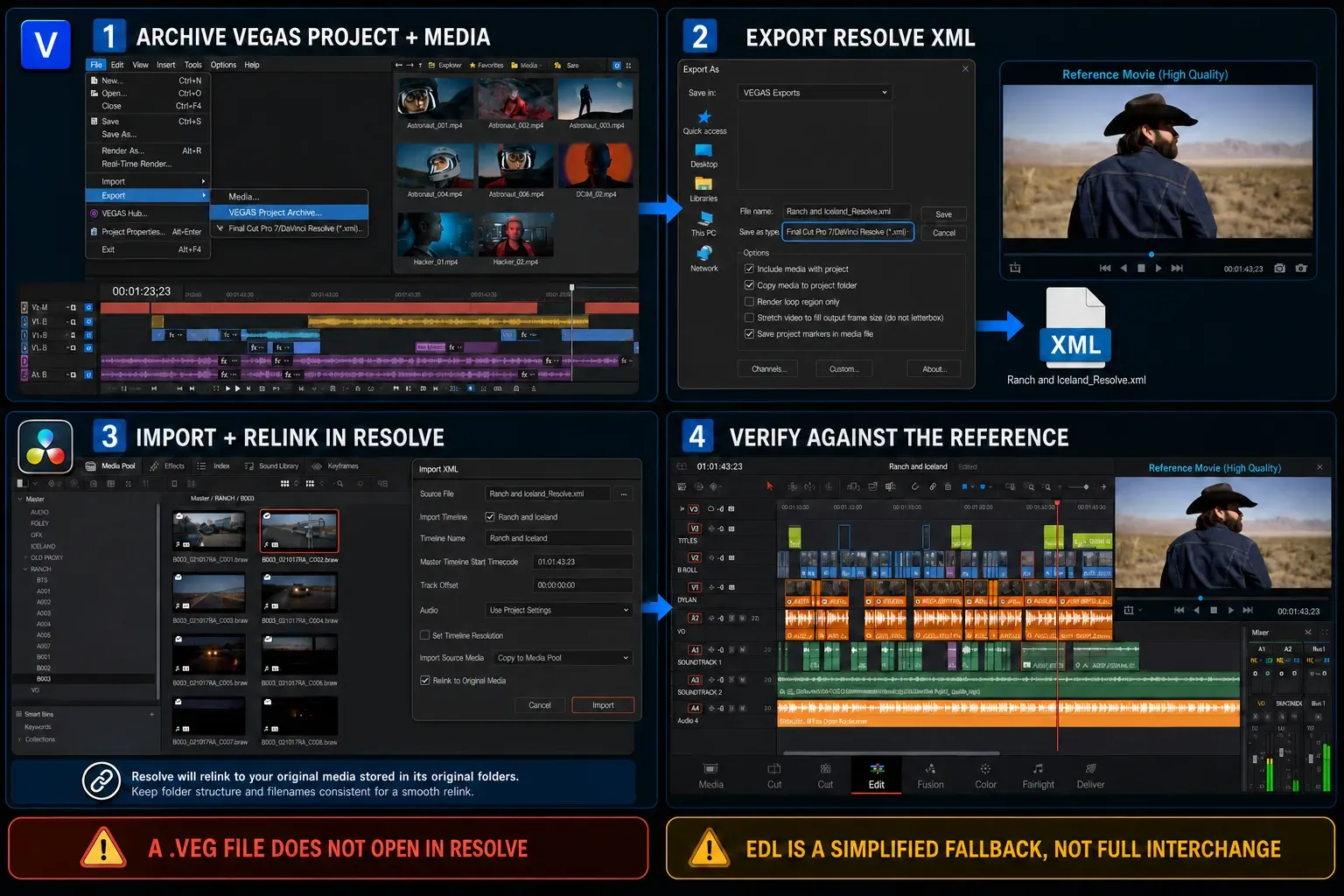
Do not use the VEGAS text EDL as a full-fidelity shortcut. The current VEGAS EDL documentation says its EDL is not intended for project interchange, can place converted events on one track and replaces transitions with crossfades. Use it only when that simplification is acceptable.
Keep VEGAS, the archive and the reference export until the Resolve master passes a shot-by-shot and audio comparison. Deleting the source environment before conform approval turns a manageable migration into archaeology.
DaVinci Resolve vs VEGAS Pro FAQ
Is DaVinci Resolve better than VEGAS Pro?
Resolve is stronger for a permanent free entry point, cross-platform work, color, Fusion, Fairlight, collaboration and structured finishing. VEGAS Pro can be better for a Windows editor who values direct event-level timeline work and the current Boris FX bundles. The representative project should decide.
Is VEGAS Pro still Sony VEGAS?
No. The historical name remains common in searches, but Boris FX acquired VEGAS Pro from MAGIX on March 30, 2026. VEGAS Pro 23 and earlier remain legacy MAGIX products; VEGAS Pro 2026 is the current Boris FX release.
Is VEGAS Pro free like DaVinci Resolve?
No. VEGAS Pro offers a full-featured 15-day Ultimate trial, not a permanent free tier. DaVinci Resolve Free can complete real projects without a normal export watermark when its codec, resolution and feature limits fit the job.
Does VEGAS Pro work on Mac or Linux?
The current VEGAS Pro 2026 system page lists Windows 11. It does not list macOS or Linux. DaVinci Resolve supports Windows, macOS and Linux, so a current Mac/Linux requirement ends this comparison in Resolve's favor.
Which is easier for beginners, VEGAS Pro or DaVinci Resolve?
VEGAS often feels faster during the first edit because trimming, effects and audio stay close to one timeline. Resolve takes longer because Edit, Fusion, Color, Fairlight and Deliver expose separate systems. That learning cost buys more finishing depth and a clearer handoff structure.
Can a VEGAS project open in DaVinci Resolve?
A native .veg file does not open in Resolve. VEGAS Pro 2026 documents Final Cut Pro 7/DaVinci Resolve XML export. Archive the project and media, export a reference, import the XML into Resolve and rebuild anything that does not survive the conform.
Is VEGAS Pro 2026 a one-time purchase?
VEGAS Pro and VEGAS Pro Plus currently offer perpetual licenses alongside subscriptions. VEGAS Pro Ultimate is subscription-only in the official launch table. Prices, bundles and promotions can change, so verify the current checkout and the exact tools included in the selected tier.
My practical verdict is narrow: VEGAS Pro 2026 wins when its Windows timeline and bundled tools shorten the work you already do; Resolve 21 wins when free access, multiple operating systems or a deeper finishing pipeline matters more. Test the second revision, then pay for the friction you actually removed.