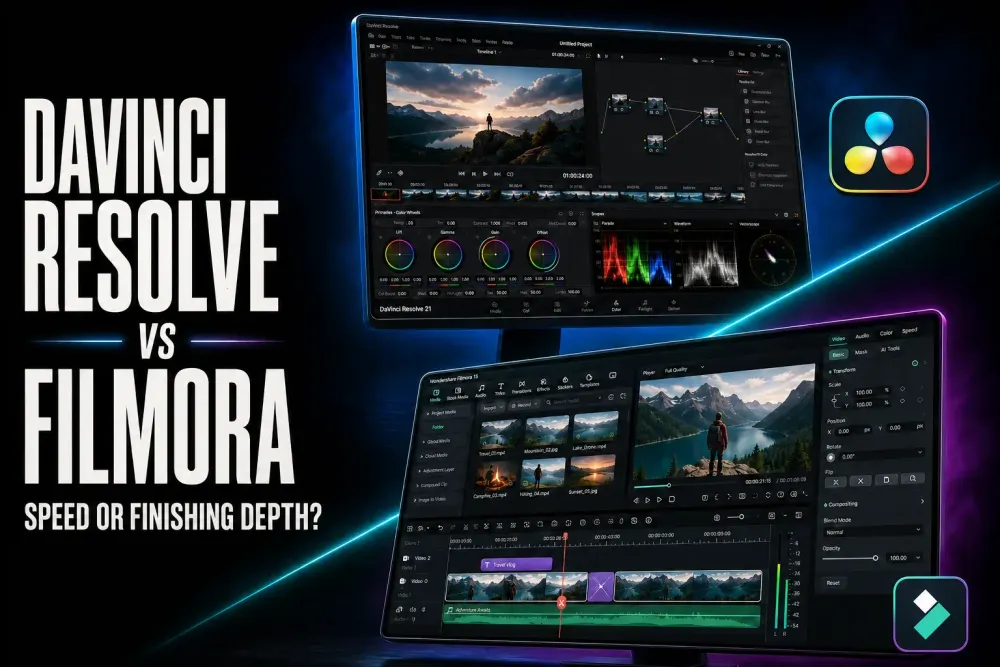
Quick answer: choose Filmora 15 when the job is to assemble a polished social or YouTube video quickly from templates, stock assets and guided AI tools. Choose DaVinci Resolve 21 when you want a watermark-free free editor, deeper color and audio control, Fusion compositing, collaboration or a workflow that can grow into professional finishing.
The uncomfortable part is that neither editor wins every beginner. Filmora can shorten the first week, but its free exports carry a watermark and several AI features use credits. Resolve costs nothing for a remarkably capable Free edition, but the interface asks you to learn a real post-production system. Paying less and learning faster are two different decisions.
This comparison uses the current major versions and the official plan pages checked on August 27, 2026. Prices and promotions can change. I would still make the final choice with one representative project, not a feature checklist.
DaVinci Resolve vs Filmora at a glance
| Decision | Practical difference |
|---|---|
| Best first fit | Filmora 15: fast creator edits, templates, stock assets and guided tools. Resolve 21: editing that can grow into color, VFX, audio, collaboration and finishing. |
| Free export | Filmora 15: available, but carries a Filmora watermark. Resolve 21: no built-in watermark for normal exports within Free-edition limits. |
| Paid model | Filmora 15: subscription or perpetual license tied to a major version. Resolve 21: Studio is a one-time purchase. |
| Learning curve | Filmora 15: faster route to a conventional creator timeline. Resolve 21: more pages and systems to learn, with a higher long-term ceiling. |
| Templates and stock | Filmora 15: central part of the workflow. Resolve 21: available, but not the core reason to choose Resolve. |
| Color, VFX and audio | Filmora 15: useful integrated creator tools. Resolve 21: dedicated Color, Fusion and Fairlight environments. |
| Desktop platforms | Filmora 15: Windows and macOS. Resolve 21: Windows, macOS and Linux. |
| Project handoff | Filmora 15: best inside Filmora's own project system. Resolve 21: built for broader post-production and interchange workflows. |
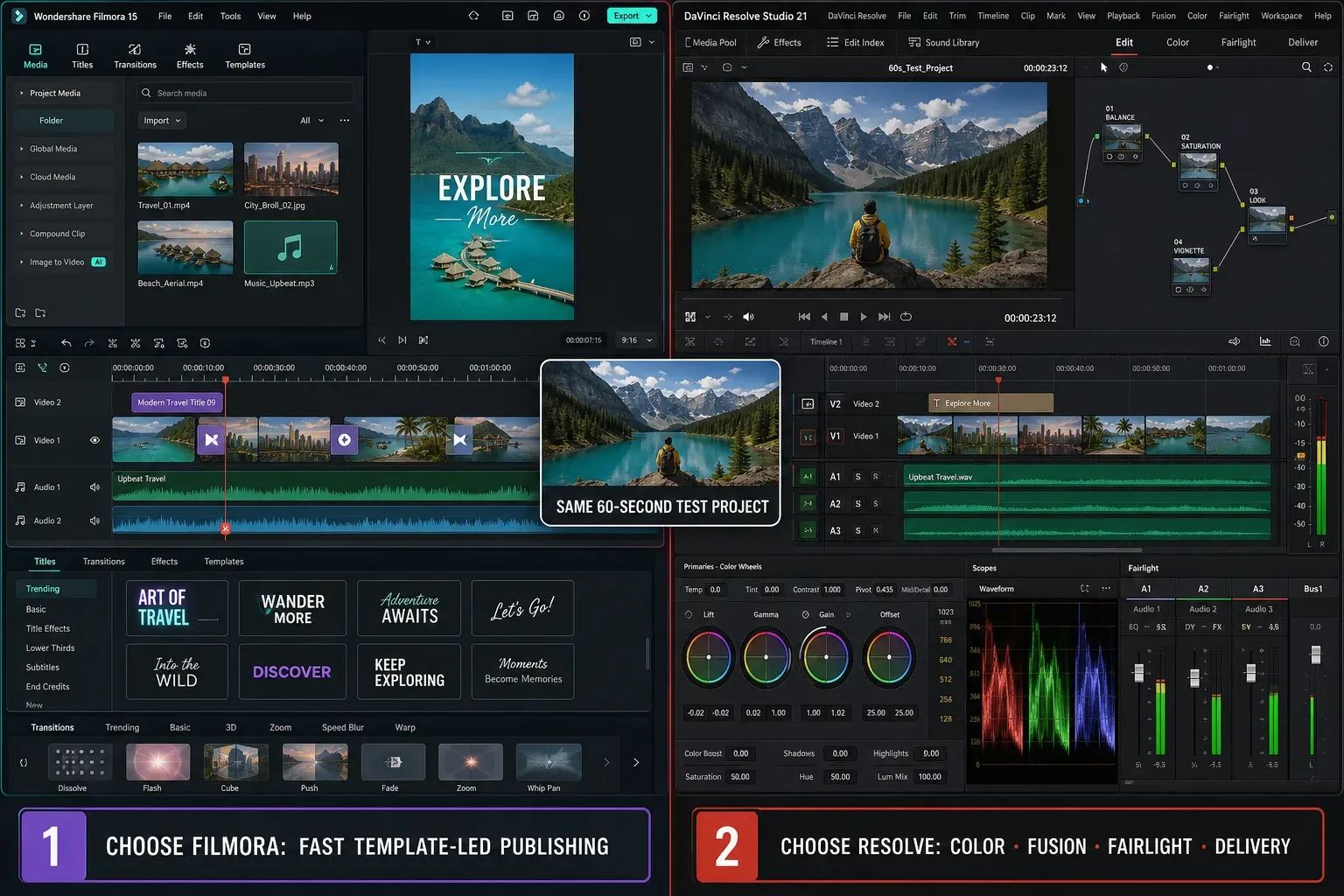
That table is a starting point, not a ranking. Filmora has moved beyond basic trimming: version 15 adds source and timeline preview, dual timelines, imported subprojects, a Pen tool and new AI features. Resolve has quick workflows too, but its advantage appears when the same project needs a serious grade, a complex composite, a controlled mix or a reliable handoff.
The DaVinci Resolve comparisons hub connects this decision to CapCut, Premiere Pro, Final Cut Pro and Resolve Free versus Studio. Use this page only for the Filmora decision.
Price: free, subscription and “perpetual” mean different things
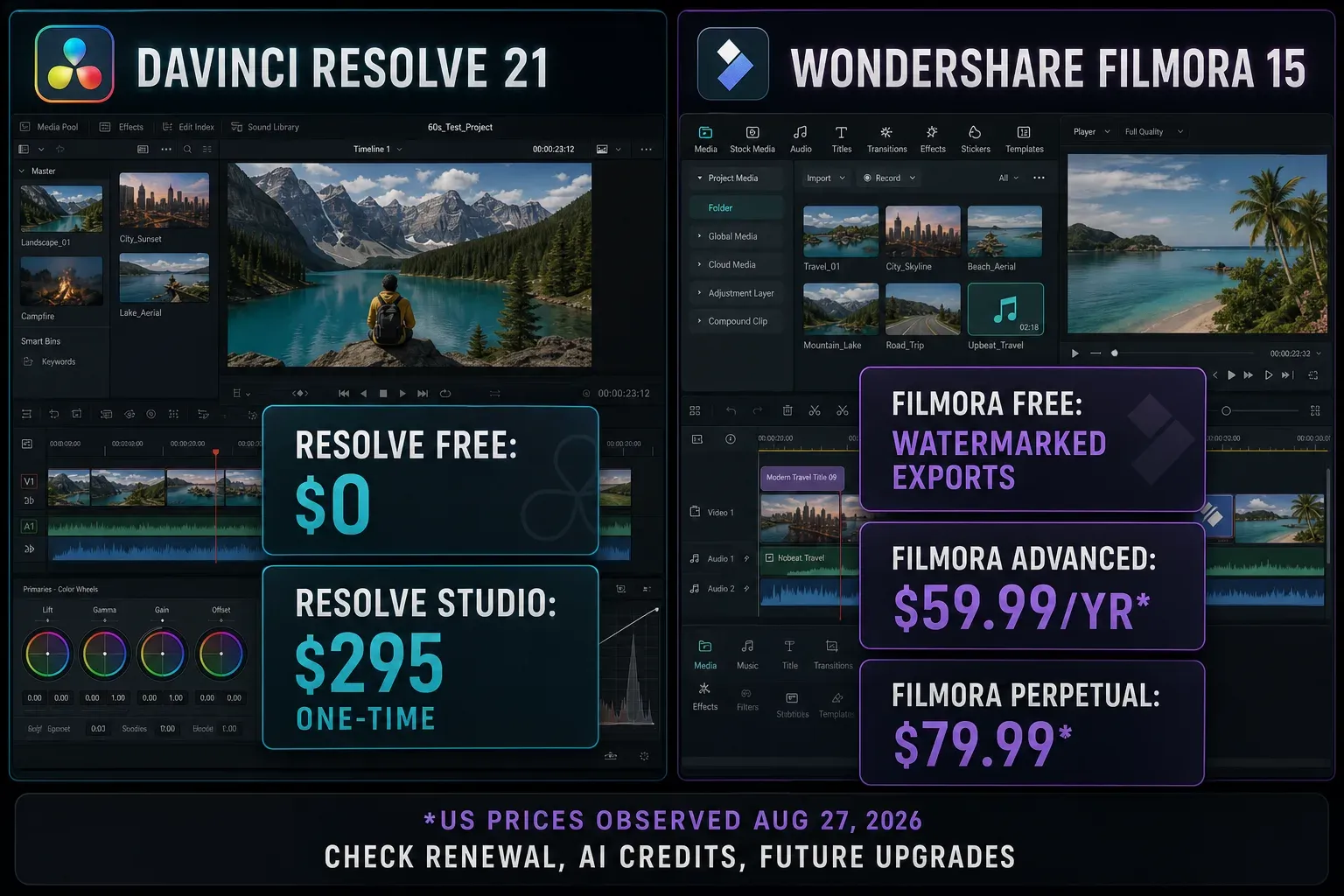
Blackmagic's current Resolve product page lists DaVinci Resolve Free at $0. It works with virtually all 8-bit formats up to Ultra HD 3840 × 2160 at 60 fps, subject to the documented format and platform limits. Normal exports do not receive a Resolve watermark. The separate Free vs Studio guide maps the features that are actually locked.
On the observed US page, DaVinci Resolve Studio was $295 as a one-time purchase. Studio raises the format and resolution ceiling and adds the DaVinci AI Neural Engine, extra Resolve FX, advanced noise reduction, Magic Mask and other professional tools. The Resolve cost guide covers license details and the checkout traps that a headline price misses.
Filmora's official pricing page listed Filmora 15 Advanced at a promotional US$59.99 per year and Perpetual at a promotional US$79.99 on August 27, 2026. The exact amount, tax and bundled Creative Assets trial can change by region or checkout session, so verify the final cart rather than copying those numbers into a long-term budget.
The two Filmora catches worth seeing before checkout
First, Filmora Free is usable for editing, but its exported video carries a watermark. Resolve Free is the stronger zero-dollar option when its codec, resolution and feature limits fit the project.
Second, Filmora Perpetual means continued use of the purchased major version, not free upgrades forever. The current page says the plan receives Filmora 15 updates only. Subscription plans include future version upgrades while the subscription remains active.
AI is another budget line. The observed Filmora Advanced plan included 1,000 AI credits per month; Perpetual included 1,000 one-time credits. Some tools remain free or have normal-speed processing rules, but credit consumption and entitlement vary. Check the row for the specific AI tool you expect to use every week.
Editing speed: Filmora reduces choices, Resolve exposes the system
Filmora is faster to understand because the conventional timeline, effects, titles and stock assets stay close to the main edit. A creator can import clips, drag in a title, apply a transition, clean dialogue and export without first understanding separate pages or node graphs.
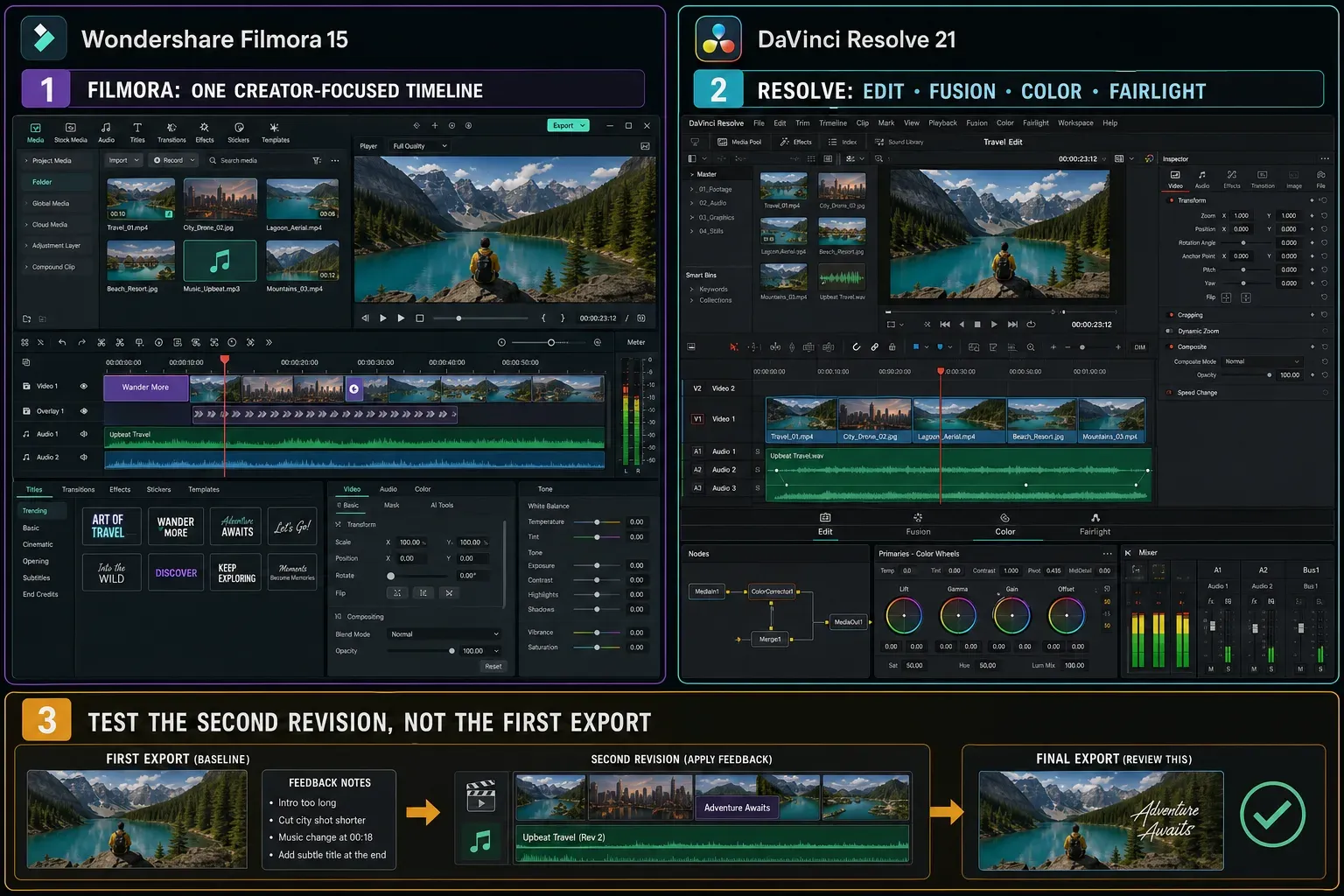
That speed is real when the template is close to the final look. It becomes less decisive when a client asks for a new aspect ratio, a precise color match, isolated dialogue repair, reusable motion graphics and a clean handoff. The shortcut saved time only if it survives the second revision.
Resolve divides the job across Cut, Edit, Fusion, Color, Fairlight and Deliver. The first project takes longer because each page has its own logic. The payoff is separation: editing decisions do not need to share one crowded panel with compositing, grading and mixing controls.
If the Resolve interface is the only thing stopping you, use the Resolve beginner tutorial to finish one short video before deciding. Twenty minutes of clicking around is not a fair comparison with an editor you already know.
Filmora 15 is not a toy, but Resolve has the deeper finishing path
Wondershare's Filmora 15 feature guide documents dual-timeline editing, imported subprojects, source/timeline preview, animated charts and a Pen tool. The wider Filmora guide also documents multicamera editing, compound clips, proxies, keyframes, masks, color wheels, scopes, LUT export, an audio mixer, EQ, denoise and ducking.
That is enough for a large amount of YouTube, course, product and social work. A beginner does not outgrow Filmora merely because they learn keyframes or start using scopes.
Where Resolve separates itself
Resolve's Color page is a grading system rather than a collection of correction controls. Node trees, tracked Power Windows, groups, versions, galleries, color management and professional monitoring create a repeatable finishing workflow. Filmora can correct and stylize a shot; Resolve is better equipped to manage a show full of shots that must match.
Fusion gives Resolve a node-based compositor inside the same project. Fairlight supplies buses, automation, routing, meters, plug-ins and delivery tools for mixes that go beyond balancing a voiceover against music. Filmora's integrated tools are easier to reach; Resolve's architecture handles more demanding revisions.
This distinction does not guarantee a prettier export. A bad color pipeline in Resolve can look worse than a careful Filmora grade. The advantage is control, diagnosis and repeatability, not magic image quality.
AI: compare the repeated task, not the feature count
Filmora packages many AI actions around creator output: short-form extraction, generation, enhancement, text and speech tools, removal and translation. That can be the shorter route when the weekly task is “turn this talking-head video into several social cuts.” Some of those actions consume credits or use different processing tiers, so the workflow has an operating cost even when the editor license is paid.
Resolve 21 also has AI-assisted editing, audio, masking and analysis, with important features reserved for Studio. Its strength is how those tools feed the rest of the post pipeline. A mask can continue into a grade or composite; dialogue work can continue inside Fairlight; transcription can drive an edit.
Write down the three AI operations you will repeat every month. Then check whether each is included, credit-metered, local, cloud-processed or Studio-only. “More AI” is not a decision until the recurring task and recurring cost are named.
Performance: test your codec and effect stack
Filmora is often recommended for modest computers and Resolve is often called demanding. Both statements can be directionally useful and still fail on your footage. H.265 10-bit camera files, screen recordings with variable frame rate, noise reduction, generated media, multicam and third-party effects stress different parts of a system.
Use the same 60-second sample in both editors:
- Import the camera file you actually use, not a downloaded demo.
- Build the same timeline resolution and frame rate.
- Add one title, one speed change, one color correction and the audio cleanup you expect.
- Scrub, play and edit for ten minutes before generating proxies.
- Export the same H.264 or H.265 delivery file and record time, failures and visible differences.
The Resolve 21 system requirements guide explains why operating system, codec, GPU memory and edition matter together. Do not buy an editor because somebody else's gaming PC exported one sample faster.
Which editor should you choose?
Choose Filmora when publishing speed is the product
Filmora is the practical choice when you want a guided timeline, ready-made titles, stock assets and AI-assisted social output in one creator-focused environment. It fits solo YouTube channels, course videos, family edits and small marketing jobs where the template or preset is already close to the approved result.
If that description sounds closer to CapCut than to a finishing suite, compare the tradeoffs in DaVinci Resolve vs CapCut. Filmora sits between them: more conventional desktop editing than a mobile-first tool, but less post-production depth than Resolve.
Choose Resolve when the project must grow
Resolve is the better long-term choice when you expect camera-format variety, controlled color, motion graphics, complex audio, multi-user work or professional delivery. Its Free edition makes that path unusually accessible, provided the footage and hardware fit its limits.
If your real alternative is an established professional subscription workflow, the more useful next comparison is DaVinci Resolve vs Premiere Pro. Filmora and Premiere solve different collaboration, ecosystem and interchange problems.
Choose neither until one controlled test is complete
Install both, finish the same short project and count the actions that mattered: media organization, rough cut, captions, title, audio cleanup, color match, revision and export. Keep the editor that removes friction from the tasks you actually repeat. A long feature list cannot tell you which interface makes you miss a deadline.
Switch from Filmora to DaVinci Resolve without losing the project
Wondershare's current project guide says a .wfp file stores editing decisions and references to source media, and can only be recognized and opened by Filmora. The current official project/export documentation observed for this comparison does not document a direct Resolve interchange route. Do not delete Filmora or promise a one-click conversion before the Resolve version is verified.
- Duplicate the Filmora project and use Archive Project so the project and referenced source files travel together.
- Export a high-quality reference movie with matching resolution and frame rate.
- Export separate clean elements when practical: dialogue, music, effects, titles with transparency and any shots that use Filmora-only effects.
- Start a Resolve project with the same frame rate before importing media.
- Rebuild the edit from original media when future revisions matter. Use the reference movie to check every cut, crop, speed change, title and mix decision.
- Keep the archived Filmora project until the Resolve export passes a frame-by-frame comparison.
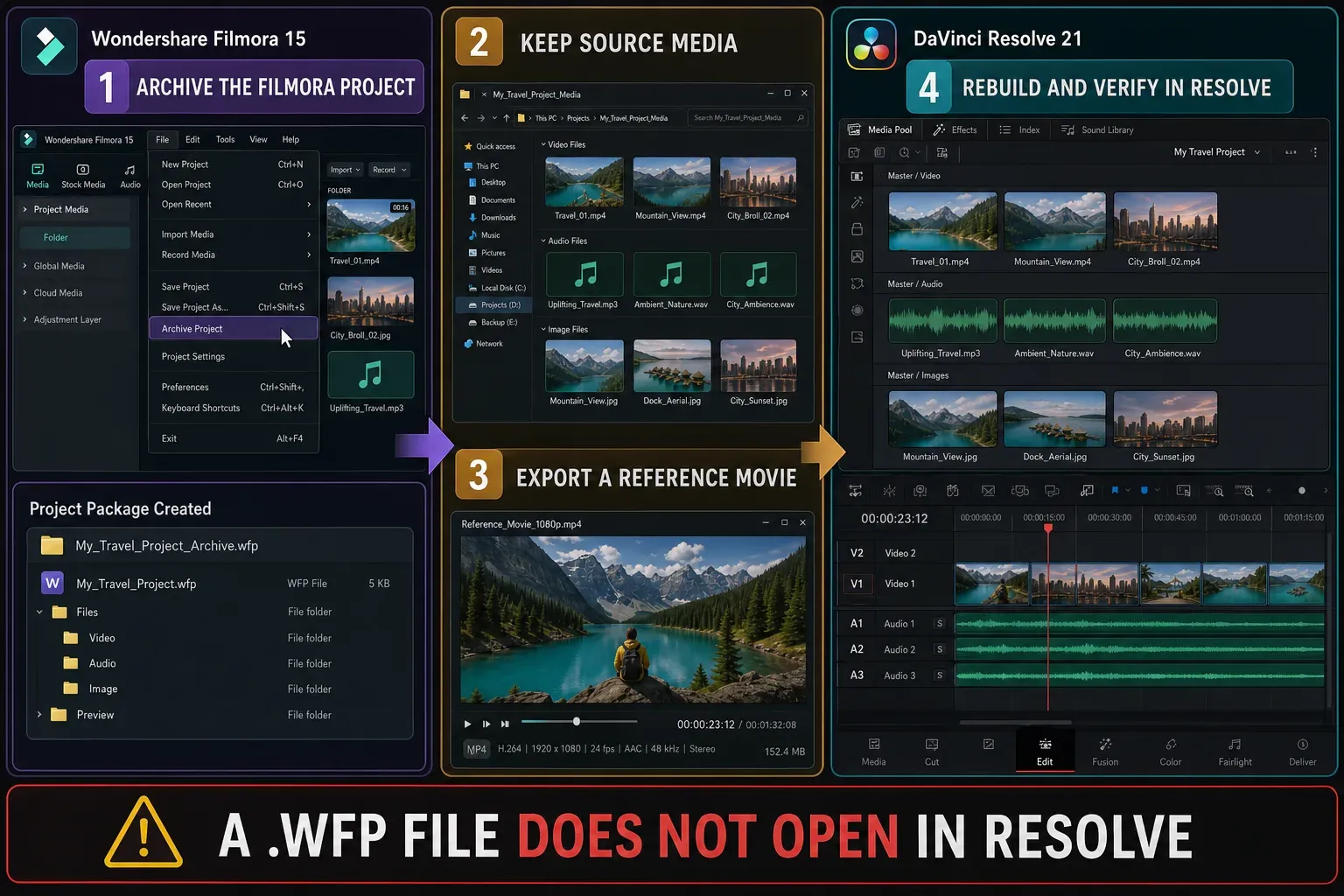
For a simple locked edit, a high-quality master may be enough for color or delivery. For an edit that will keep changing, rebuilding from source media is slower but safer than cutting a compressed master into pieces and pretending the original timeline transferred.
DaVinci Resolve vs Filmora FAQ
Is DaVinci Resolve better than Filmora?
Resolve is stronger for color, Fusion compositing, Fairlight audio, collaboration and workflows that must scale. Filmora can be better for a creator who values templates, stock assets and a faster first edit. The better editor is the one that completes your representative project with fewer unacceptable compromises.
Which is easier for beginners, Filmora or DaVinci Resolve?
Filmora is usually easier during the first project because its creator tools stay close to one conventional timeline. Resolve takes longer to learn because Cut, Edit, Fusion, Color, Fairlight and Deliver have separate jobs. Resolve's learning cost buys more control later.
Is DaVinci Resolve Free better than Filmora Free?
Resolve Free is the stronger choice when you need a finished export without a built-in watermark and its codec, resolution and feature limits fit the job. Filmora Free allows editing and export, but the official plan page says exported videos carry a Filmora watermark.
Is Filmora 15 good enough for YouTube?
Yes, for many channels. Filmora 15 provides a multitrack timeline, titles, templates, stock assets, color and audio controls, captions and creator-focused AI tools. Resolve becomes more attractive when the channel needs deeper grading, compositing, mixing, collaboration or demanding delivery formats.
Does Filmora have color grading?
Yes. Filmora's current guide documents HSL, curves, color wheels, scopes, keyframed adjustments and LUT export. Resolve still provides the deeper dedicated grading architecture for matching many shots, tracked corrections, color management and professional finishing.
Can Filmora projects open in DaVinci Resolve?
No direct opening route is documented in the official guides checked for this comparison. Wondershare says .wfp files can only be recognized by Filmora. Archive the Filmora project and sources, export a reference, then rebuild or conform the work in Resolve without assuming effects and titles will translate.
Is Filmora a one-time purchase?
Filmora offers a Perpetual plan as well as subscriptions. The official plan page says Perpetual covers continued use and updates within the purchased major version, currently Filmora 15, but not future major-version upgrades. Prices and bundled trials can change, so verify the checkout terms.
My practical verdict is simple: Filmora wins the race to a good first creator edit; Resolve wins when the same project needs a second life in color, VFX, audio, collaboration or professional delivery. Pick the friction you can afford now without hiding the ceiling you may hit later.